Anxiety Therapist: “I Sent Myself to the ER Twice in One Week — Then Discovered the 60-Year-Old Science That Stops 3am Panic Without Medication”

DUBAI — “I tell my patients all the time that anxiety is a body problem, not a mind problem,” says one anxiety therapist at a private wellness clinic in Dubai. “I just never expected to become my own case study.”
The therapist, 38, has spent the last decade helping clients work through panic disorders, sleep anxiety, and what she calls “the 3am spiral.” She knows the clinical language. She knows the research. She knows every tool in the toolkit.
None of it prepared her for the night it started happening to her.
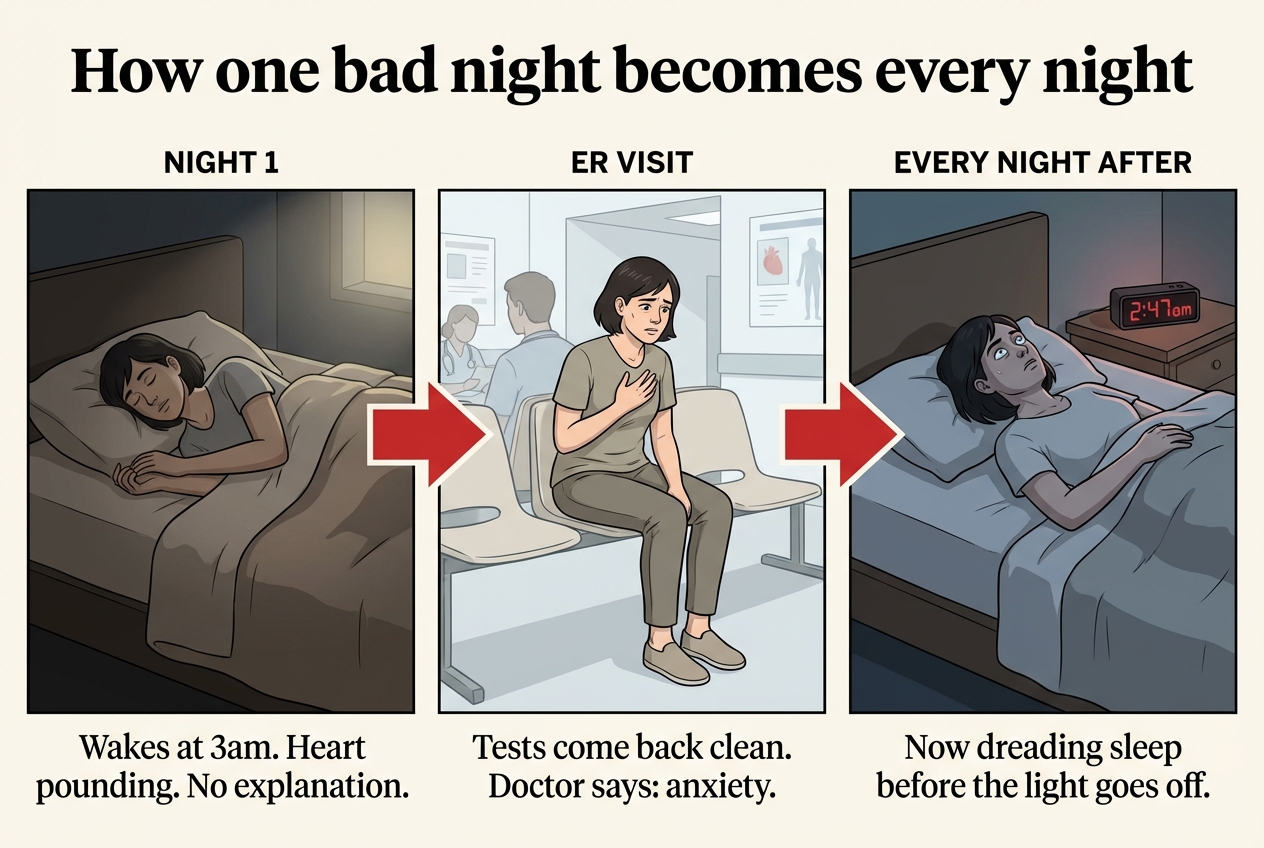
“I woke up and my heart was pounding so hard I could see it through my shirt,” she recalls. “My chest was completely locked. I couldn’t take a full breath. I’m a therapist — I know what a panic attack is. I know it’s not dangerous. And I was still completely convinced I was dying.”
Her husband drove her to the emergency room at 3am.
Every test came back clean.
“The cardiologist was lovely,” she says. “He told me my heart was in perfect health. He said it was anxiety. He gave me a referral — to a therapist.” She laughs quietly. “I am the therapist.”
She went home. She got back into bed. She lay in the dark and waited for it to happen again.
Five nights later, it did.
The Second Visit Changed Everything
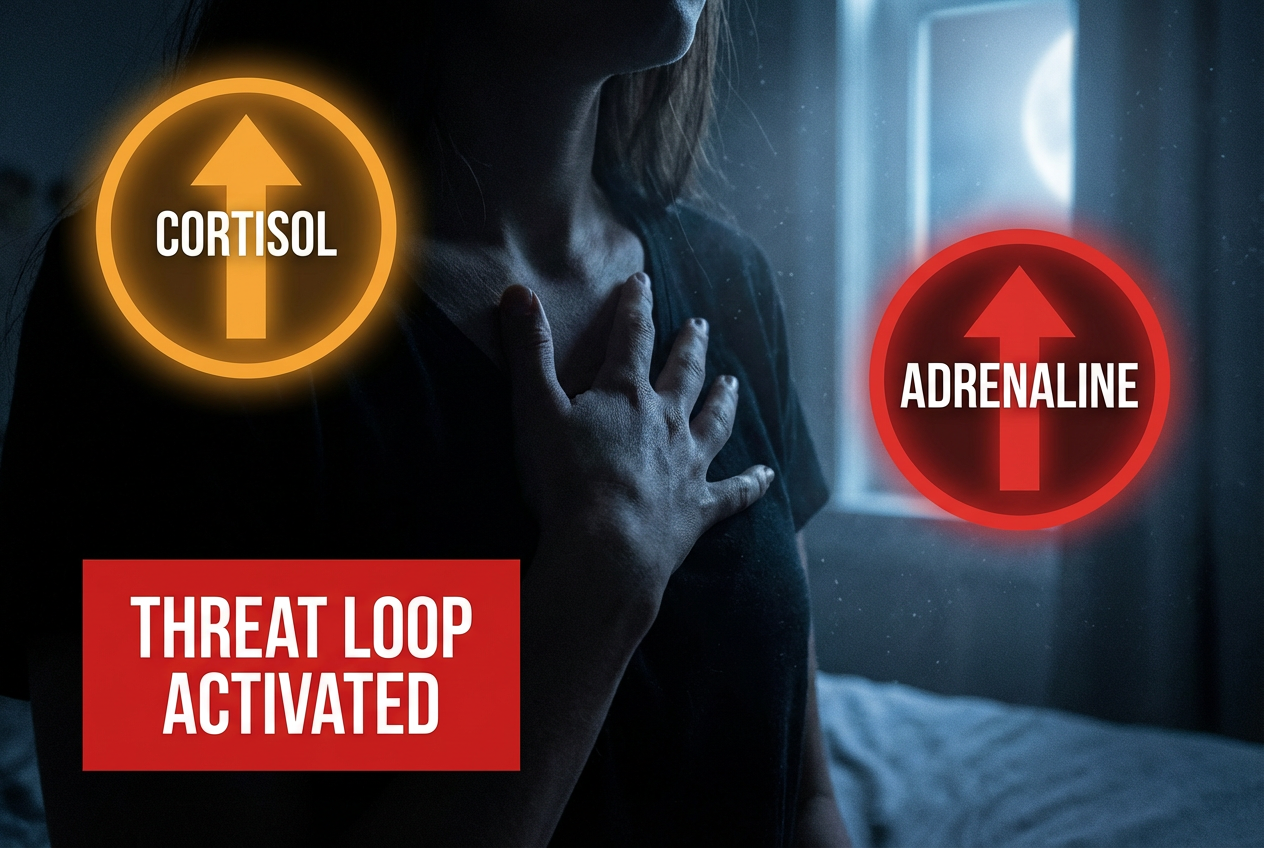
The second ER visit was not worse because the symptoms were more severe. It was worse because she already knew the outcome before she arrived.
“I sat in that waiting room knowing they weren’t going to find anything,” she says. “And that knowledge made it worse, not better. Because if nothing is wrong with me — if every machine they have says I’m completely healthy — then the only explanation left is that my own nervous system is generating something that feels exactly like dying. On purpose. Every night.”
She was 38 years old. She treated anxiety for a living. And she was now afraid to fall asleep in her own bed.
“I started dreading bedtime hours before it arrived. A low hum of ‘what if tonight is the night’ that would build in my chest from around 9pm. I was anxious about being anxious. My own nervous system had become the threat.”
She increased her own therapy sessions. She adjusted her sleep hygiene. She did everything she would tell a patient to do.
It kept happening.
“I Had Every Tool. None of Them Worked at 3am.”

What the therapist experienced over the following months is a list that will feel familiar to anyone reading this.
She used the Calm app. She completed sleep meditation after sleep meditation. Her mind would quiet for ninety seconds and then snap back to full alert — heart already accelerating before the thought had even fully formed.
She bought a weighted blanket — the most-recommended item in her own clinical toolkit. It helped for the first two weeks. Then it started getting hot. Then it started sliding off the bed. Then it spent three months folded on a chair before she moved it to the storage room.
She tried every approach a trained professional would reach for: magnesium, breathwork, progressive muscle relaxation, cognitive restructuring before bed. Each one helped slightly. None of them were there at 3am when the alarm activated and her brain went fully offline.
She pauses.
“I had spent ten years handing my patients the wrong category of solution. Good tools. Wrong category.”
“And Then I Looked at What Was Happening Around Me”
It was around this time that the therapist started paying closer attention to something she had been professionally trained to ignore: the world outside the therapy room.
The news her patients were absorbing — and that she herself could not stop absorbing — had changed in character. Not subtly. Dramatically.
Regional conflict had been escalating for over two years. Wars that felt distant had become daily news items with faces and names attached. Economic uncertainty was no longer a background hum — it was a headline every morning. Colleagues in her field were reporting something they had never seen before: a wave of patients with no prior anxiety history, suddenly presenting with nocturnal panic. Adults in their 30s and 40s. High-functioning people. People who, by every measure, had their lives together.
“I started asking them all the same question,” she says. “‘When did this start?’ And almost all of them gave me the same answer. They couldn’t pinpoint an exact moment. But it was somewhere in the last two years. After things started feeling... louder.”
The data confirmed what she was seeing in her clinic.
For residents of the Middle East and Gulf specifically, the past two years had been uniquely exhausting. The region entered 2026 carrying unresolved conflicts across multiple fronts — with experts warning that any single escalation could pull the wider region into major new violence. These were not abstract geopolitical abstractions. For millions of people living in Dubai, Abu Dhabi, and across the Gulf, they were the last thing seen on a phone screen before turning off the light. And the first thing the brain reached for at 3am when it snapped awake looking for danger.
“Your nervous system doesn’t distinguish between a threat to your body and a threat to your world,” the therapist explains. “It responds to both the same way. It activates. It puts you on high alert. And then it waits.”
She had been telling her patients this for years. She had never fully felt it herself until now.
“I realized that what I was experiencing — and what hundreds of thousands of people in this region are experiencing right now — wasn’t a disorder. It was a logical response to an illogical amount of input. The world had become genuinely more frightening. And our nervous systems were doing exactly what they were designed to do.”
The problem was not the alarm. The alarm was appropriate.
The problem was that nobody had given them a way to turn it off.
The Pattern She Recognized in Her Own Patients

It was this realization that sent her back through her own case files.
She pulled records from the past three years. Patients who had presented with nocturnal panic. Patients who had done everything right — therapy, medication, lifestyle changes — and still woke up at 3am with their hearts pounding.
A pattern emerged that she had never fully named before.
“Almost every single one of them described the same progression,” she says. “It starts with waking up a little earlier than normal, heart beating a little faster. Then one night it escalates into a full crisis — chest pain, can’t breathe, ER visit, clean tests. Then something shifts. The body starts anticipating the panic before it arrives. It starts sleeping lightly. Bracing. And that bracing — that constant vigilance — is what feeds the cycle.”
“I realized I had been treating the symptom — the panic attack itself — without addressing the mechanism underneath it,” she says. “The body was stuck in a threat loop it didn’t know how to exit. And everything I was offering required the brain to do the exiting. But the brain wasn’t available.”
She knew what the body needed. She had read the research years earlier and filed it away as theoretical. Now, at 3am on a Tuesday, sitting on her bathroom floor with her back against the cold tile, she went looking for it again.
The 60-Year-Old Discovery She Had Dismissed
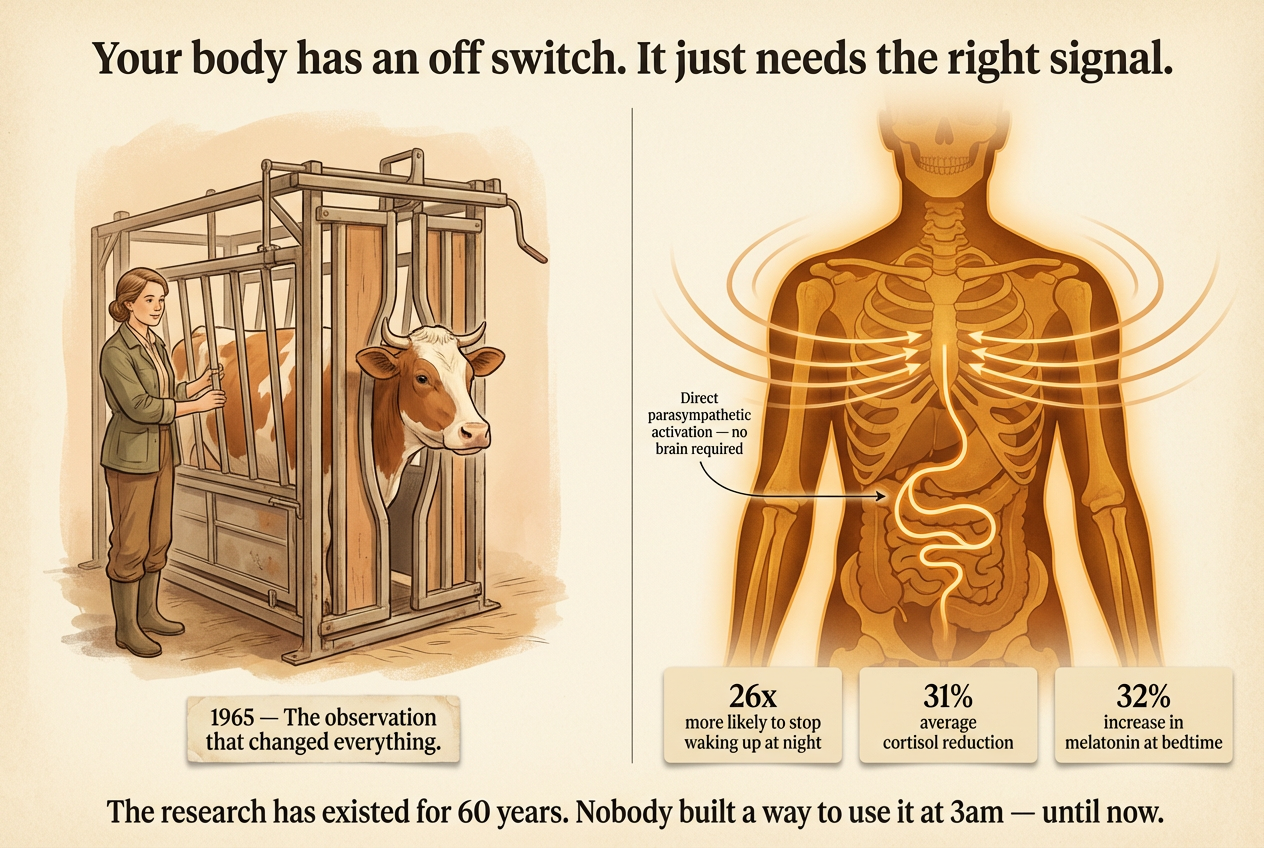
In 1965, a scientist named Temple Grandin was struggling with anxiety attacks she could not control.
She was not a therapist. She was not a neuroscientist. She was a young researcher visiting a cattle farm who noticed something that would eventually reshape how we understand the human nervous system.
Cows entering a squeeze chute — a device that applied firm, even pressure to both sides of their bodies — would transform almost instantly. An animal that had been kicking, thrashing, and in full panic would go still within seconds. Not sedated. Not restrained by force. Genuinely calm.
Grandin wondered if the same pressure signal would work on her own nervous system. She built a device. She tested it on herself during an anxiety episode.
The panic stopped.
She published her findings in 1992. A clinical trial in 2020 confirmed them at scale. The mechanism she identified is now one of the most replicated findings in anxiety neuroscience — and one of the least discussed outside of occupational therapy.
“I had read Grandin’s work in graduate school,” the therapist admits. “I remember thinking it was fascinating. I filed it under ‘interesting but not applicable.’ Because we don’t give patients squeeze chutes. We give them apps.”
She had never connected it to what her patients — and now she herself — were experiencing at 3am.
That night, she did.
Why Everything She Had Tried Was The Wrong Category

Sitting on her bathroom floor at 3am, the therapist ran through every tool she had used — and every tool she had recommended — through this new lens.
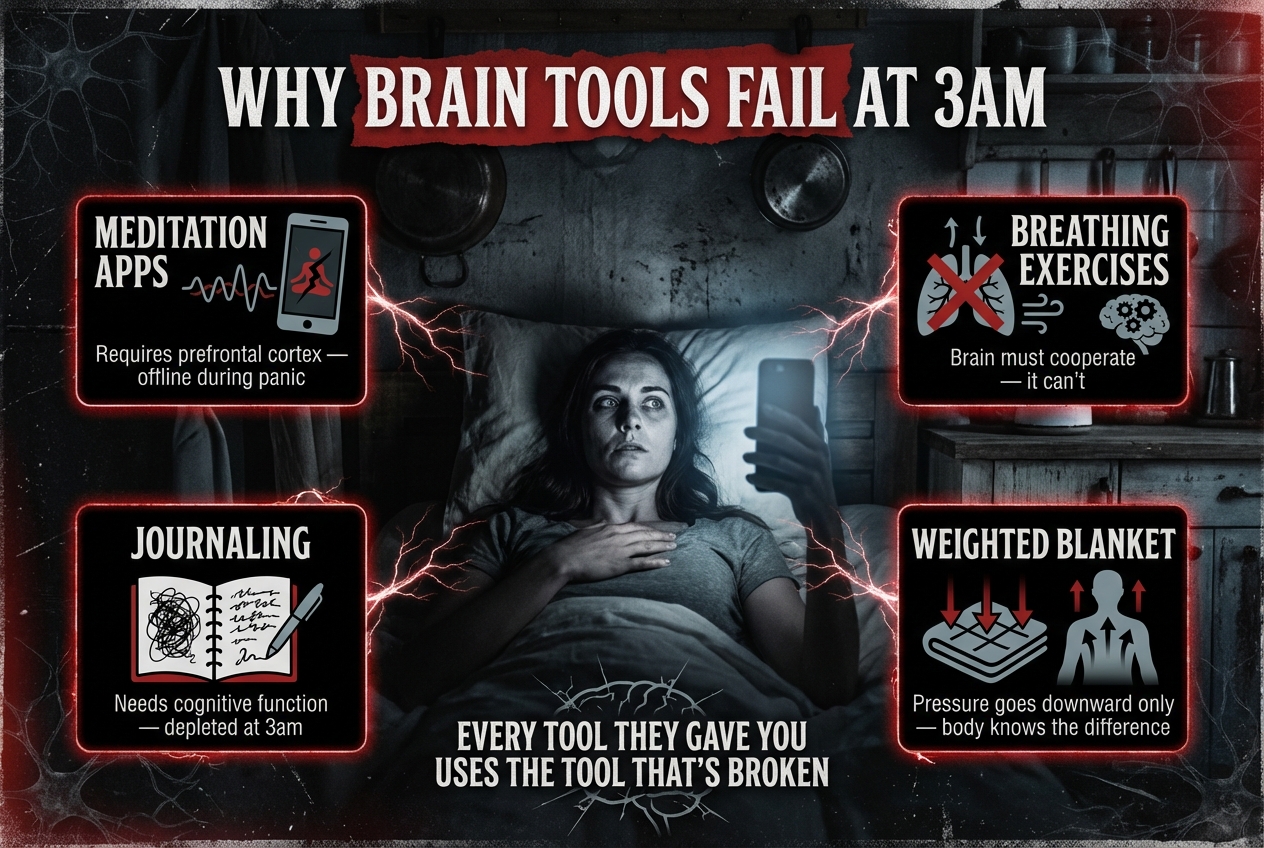
Breathing exercises. They work by engaging the prefrontal cortex to regulate the nervous system. Requires the brain to cooperate. Unavailable at 3am.
Meditation apps. Same mechanism. Same failure point.
Journaling. Requires cognitive engagement. The exact resource the alarm state depletes first.
Weighted blanket. This one is close, she thought. The pressure principle was right. But a weighted blanket lies on top of you. It doesn’t hold you. The body knows the difference.
A blanket cannot do that. A blanket is the right category. Wrong execution.
She picked up her phone and searched for something she had vaguely seen scrolling past on social media and dismissed as a children’s product.
What she found was not a children’s product.
What She Found At 2am
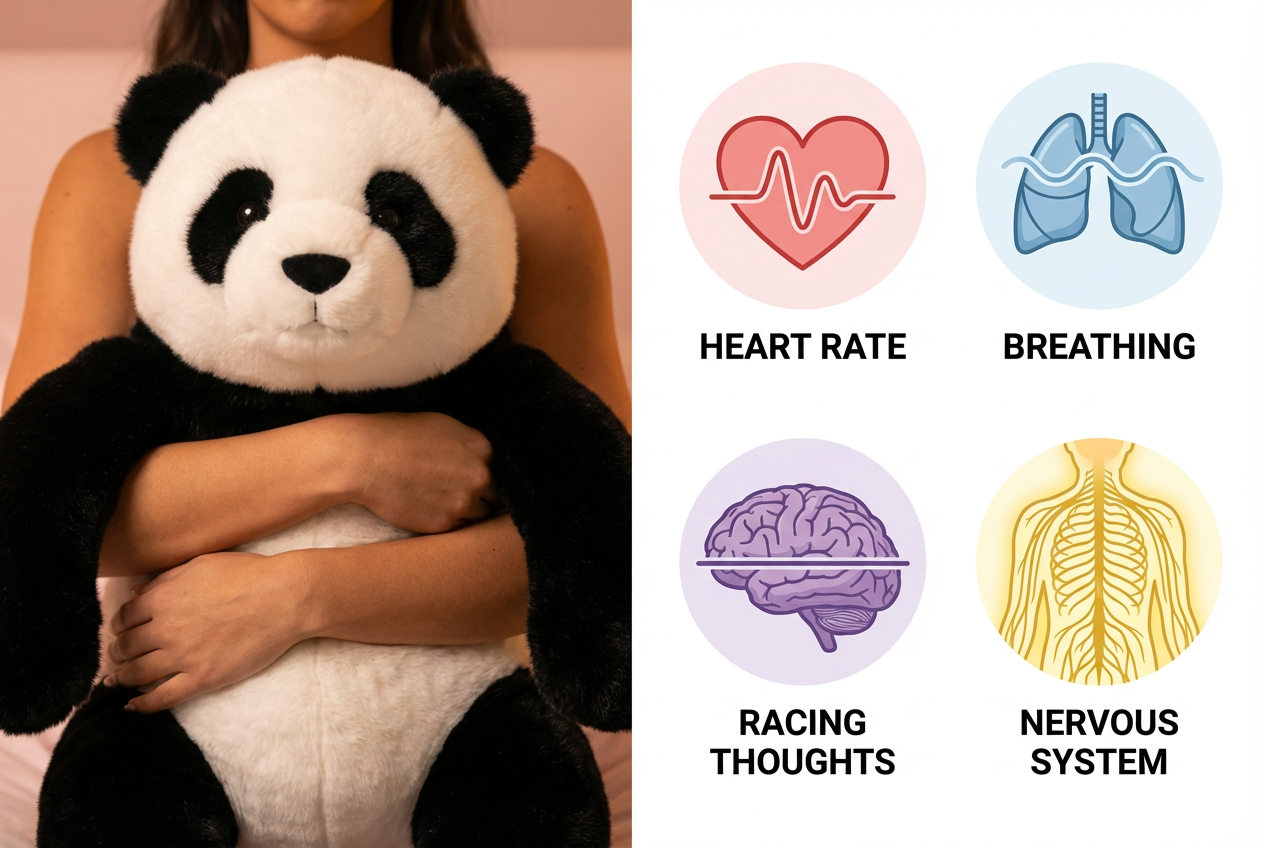
The product that came up was called the Grounding Pookie. A weighted stuffed panda.
Her first reaction was immediate and dismissive. “I genuinely thought it was a children’s toy someone had rebranded for anxious millennials,” she says. “I almost closed the tab.”
She didn’t close the tab.
“Something made me keep reading. Maybe because it was 2am and I had nothing left to lose. Maybe because the page described exactly what I had been experiencing — the 3am wakeups, the chest tightness, the brain that wouldn’t cooperate with any tool I tried. It didn’t read like a product description. It read like someone had been in my bedroom.”
She read about the deep pressure mechanism. The parasympathetic activation. The clinical trial data she had filed away as theoretical years earlier, now packaged into something she could actually hold.
“As a therapist, I should have connected these dots years ago,” she admits. “The research was there. I just never thought about it in the form of something you could pick up at 3am when you couldn’t sleep.”
She scrolled to the bottom of the page. She looked at the price. She looked at the guarantee — 30 nights, full refund, no questions.
“I thought — I have spent $175 on a single therapy session that did nothing for my 3am wakeups. I have spent $90 on a weighted blanket that is in my storage room. This costs less than either of those. And if it doesn’t work I get my money back.”
She ordered it at 2:14am.
It arrived four days later.
“I Felt Ridiculous For About 30 Seconds”
The therapist is careful to be precise about the first night.
“I want to be honest,” she says. “When I picked it up out of the box, I felt slightly ridiculous. I am a 38-year-old professional. I treat anxiety for a living. And I was holding a stuffed panda in my kitchen wondering what I was doing.”
She almost put it back in the box.
“Then I held it properly — both arms around it, pulled it close to my chest — and something happened that I was not prepared for. My shoulders dropped. Immediately. Before I had even decided to relax. My body just... responded.”
She stood in her kitchen for a moment, surprised.
“That involuntary response — that immediate physiological shift before conscious thought — is exactly what Grandin’s research describes. The pressure signal reaches the nervous system before the brain has time to evaluate or overthink it. I knew this intellectually. Feeling it was completely different.”
She took it to bed.
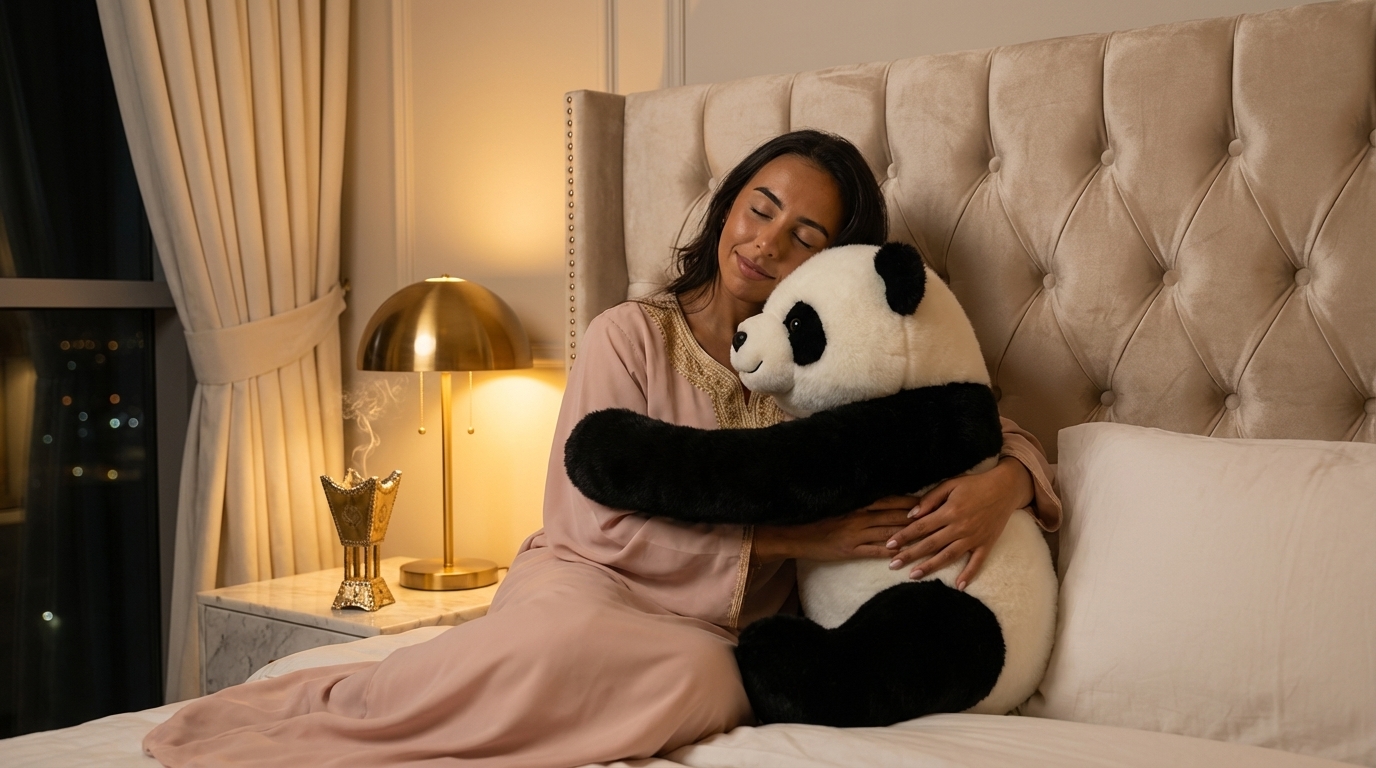
The Night The Alarm Didn’t Come
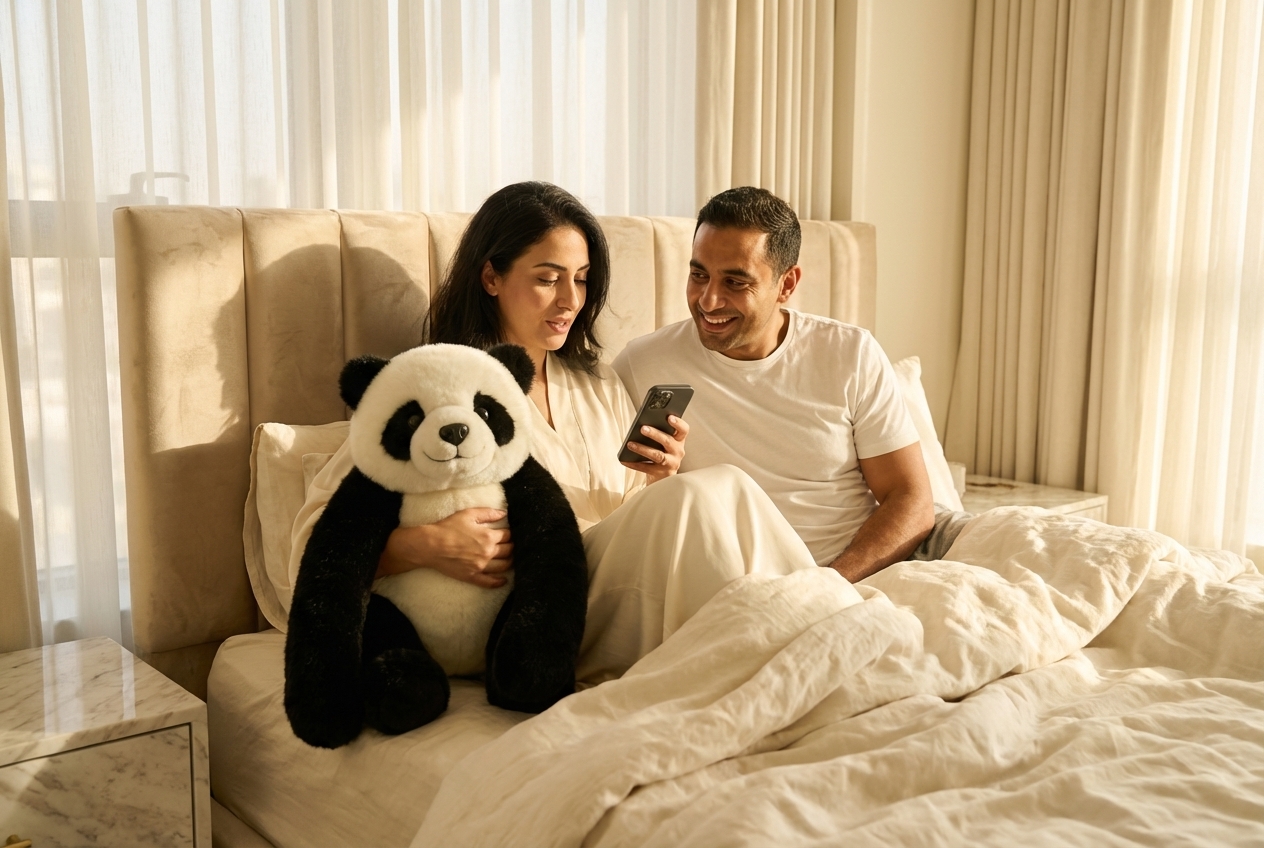
“I woke up at 6:47am,” she says quietly.
She had gone to bed at 11pm. She had held the panda against her chest as she fell asleep. She had not woken up at 3am. She had not lain in the dark bracing. She had not checked her heart rate on her watch or stared at the ceiling running through worst-case scenarios.
She had slept for seven hours and forty-seven minutes.
“I lay there for a moment not fully believing it,” she recalls. “Because my first thought was — was that real? Did that actually just happen? I had woken up every single night for eight months. And that night I didn’t.”
She is careful, as a clinician, not to overstate a single data point.
“One good night doesn’t prove anything,” she says. “I know that. But one good night after eight months of bad ones felt like a lot.”
The second night she slept through again.
The third night, she woke briefly at 3am — old habit — reached for the panda, pulled it to her chest, and was back asleep within minutes.
Why The Weighted Blanket Failed — And Why This Is Different
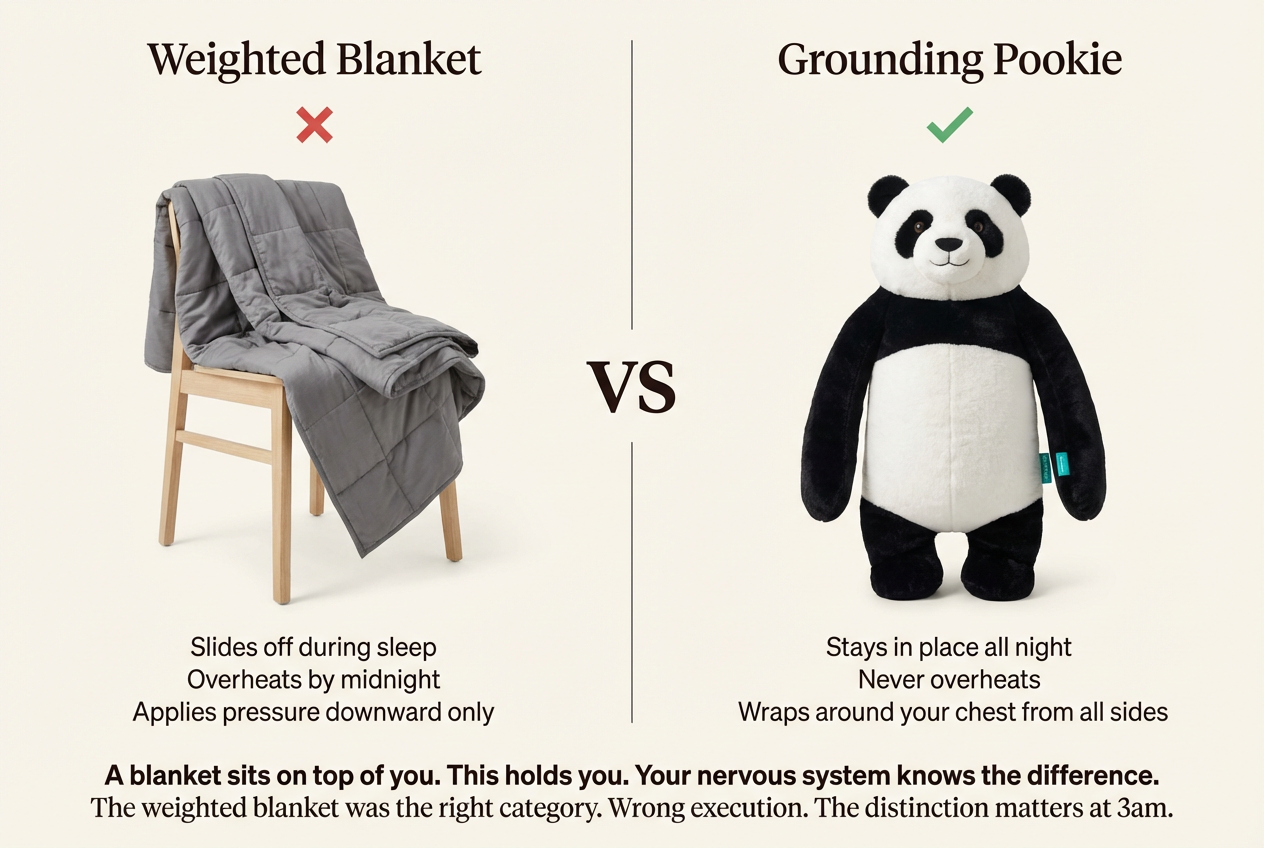
In the weeks that followed, the therapist went back through her clinical notes on weighted products and started asking the question she had never fully asked before: why had the blanket not worked the same way?
The answer was straightforward once she looked for it.
“A weighted blanket applies pressure downward,” she explains. “It sits on top of you. The weight is distributed across your legs and lower body, and it shifts every time you move. By 3am, most people have kicked it off, rolled out from under it, or it’s gotten too hot.”
More importantly, she explains, a blanket cannot replicate the specific pressure signal the nervous system is looking for.
“The research on deep pressure therapy — Grandin’s original work and everything that followed — consistently identifies circumferential pressure as the most effective signal. Pressure that wraps. That applies to the chest and torso from multiple directions simultaneously. The pressure that most closely replicates being held.”
“A blanket is the right category,” she says. “Wrong execution. It’s like knowing you need antibiotics and taking a vitamin. You understood the problem. You just didn’t have the right tool.”
She now recommends the Grounding Pookie to every patient who presents with nocturnal anxiety. She keeps one in her clinic for patients to hold during sessions.
“The moment I put it in someone’s arms during a session, I watch their posture change within thirty seconds. Every time. That’s not placebo. That’s a nervous system receiving a signal it recognizes.”
The Science She Should Have Known Sooner
For readers who want to understand exactly why this works, the therapist breaks it down the way she now explains it to patients.
“Your nervous system has two modes,” she says. “Sympathetic — fight or flight, high alert, danger mode. And parasympathetic — rest and digest, safety mode. When you wake up at 3am panicking, your sympathetic system has activated. Your heart races. Your chest tightens. Your brain starts generating threats to justify the alarm that’s already going off.”
The problem, she explains, is that every conventional anxiety tool tries to switch off the sympathetic system by working through the brain. Breathing exercises. Cognitive reframing. Meditation. All of them require the prefrontal cortex to override the alarm.
“But when you’re in full sympathetic activation, the prefrontal cortex is suppressed,” she says. “The alarm has effectively taken your reasoning offline. You cannot think your way calm because the part of your brain responsible for rational thought is the first casualty of the panic response.”
Deep pressure works differently.
“Firm pressure on the chest and torso sends a direct signal through the peripheral nervous system to the vagus nerve — bypassing the brain almost entirely. The vagus nerve is the primary pathway of the parasympathetic system. Stimulating it directly triggers the relaxation response without requiring any cognitive cooperation.”
“These are not small effects,” the therapist emphasizes. “A 31% cortisol reduction is clinically significant. And 26 times more likely to stop waking up at night — that is not a marginal improvement. That is a category difference.”
See Why Thousands Have Made the Switch
The Grounding Pookie is currently available with a special introductory discount
Check Availability NowWhat Her Patients Are Saying
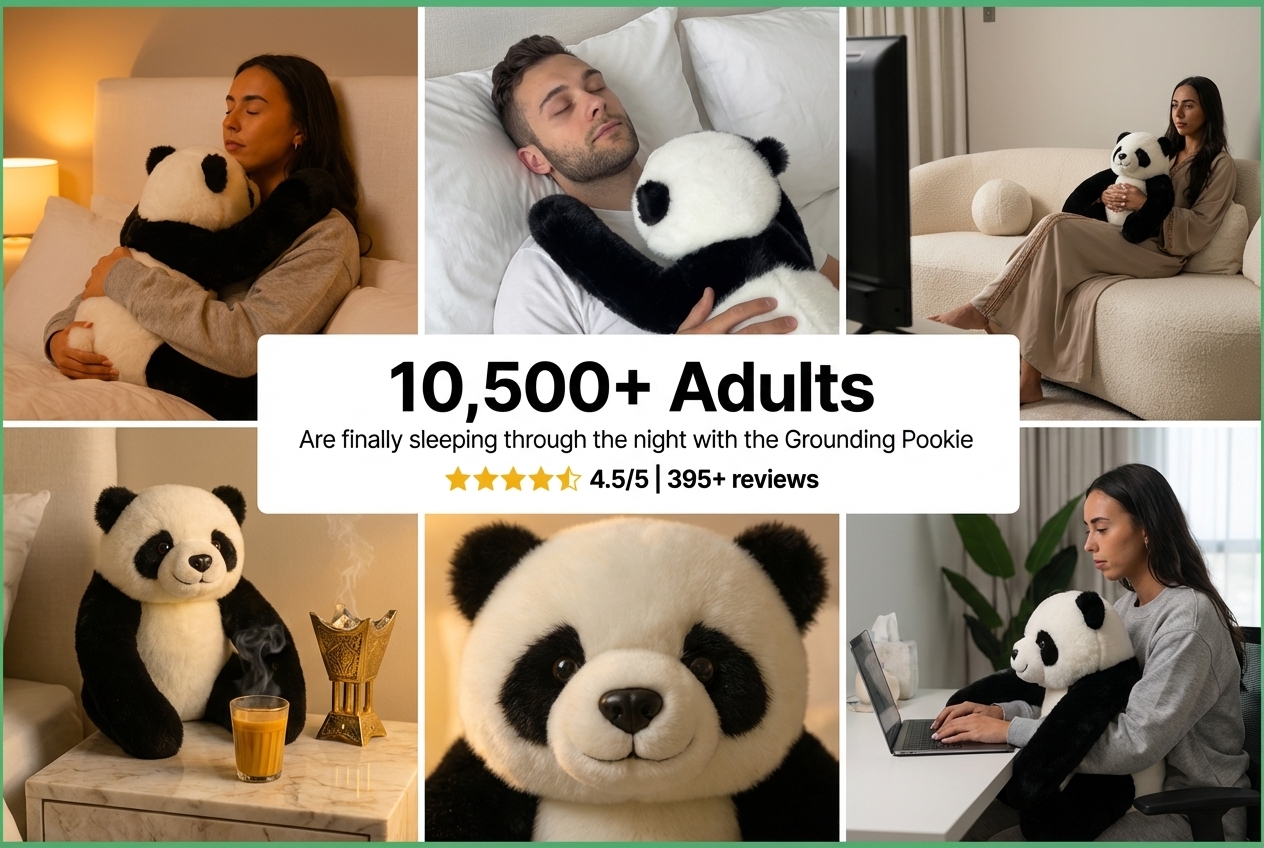
Since the therapist began recommending the Grounding Pookie to her clients, the responses have been consistent enough that she no longer considers them anecdotal.
“I had been waking up at 3am every single night for almost a year. I had done everything — therapy, medication, the weighted blanket, the apps. My therapist suggested this and I thought she had lost her mind. The first night I held it I slept until 6am. I cried when I woke up. I didn’t know what a full night’s sleep felt like anymore.”
— Layla R., 41, Dubai“I went to the ER twice last year thinking I was having a heart attack. Both times they told me it was anxiety. I went home both times and lay in bed waiting for it to happen again. I ordered this on a Tuesday night at 1am because I had nothing else to try. I have not woken up in a full panic since. That was eleven weeks ago.”
— Sara M., 36, Abu Dhabi“I want to be clear that I am not someone who buys things like this. I am an engineer. I need data. My wife sent me the research and I read it and I still thought it was ridiculous. She ordered one anyway. I tried it once because she asked me to. I slept for eight hours. I ordered my own the next morning.”
— Khalid A., 47, DubaiThe Cost Question
The therapist addresses this directly, because she knows it will come up.
“When I first saw the price I thought — that’s reasonable,” she says. “Then I thought about what my patients spend trying to fix this problem. One therapy session with me is 600 dirhams. That’s a standard rate in Dubai. Most of my patients see me weekly. That’s 2,400 dirhams a month on therapy alone — which helps enormously, but does nothing for the specific moment at 3am when the alarm goes off.”
She continues.
“The weighted blanket most of them own cost between 300 and 500 dirhams and is in a closet somewhere. The Calm app subscription they pay for monthly costs 300 dirhams a year and has a 90-second average session length for people with nocturnal anxiety before they give up. The melatonin. The magnesium. The CBD products. Add it up over a year and most of my patients have spent thousands of dirhams on tools that partially work.”
The Grounding Pookie retails at a fraction of a single therapy session.
“And unlike a therapy session,” she says, “it is available at 3am. It does not require an appointment. It does not need you to be cognitively functional. It works when you are at your absolute worst — which is the only time it actually matters.”
The “Too Good To Be True” Question
The therapist anticipates the skepticism. She felt it herself.
“I am a scientist,” she says. “When something sounds too simple, my instinct is to look for the catch. So I looked.”
She went back through the peer-reviewed literature on deep pressure therapy. She read the original Grandin research. She read the 2020 clinical trial. She read the occupational therapy studies. She read the cortisol and melatonin data.
“The mechanism is not complicated and it is not new,” she says. “It has been in the research literature for sixty years. What is new is the delivery format — something that actually wraps around your chest, that you can hold at 3am, that stays in place when you move, that doesn’t overheat, that works precisely at the moment you need it most.”
She pauses.
“The research was always there. We just never gave people a way to use it in the middle of the night when their brain had gone offline.”
Her Recommendation
“I am not a salesperson,” the therapist says. “I am a clinician who became her own patient and found something that worked when nothing else did.”
“If you are waking up at 3am with your heart pounding. If you have been to the ER and the tests came back clean. If you have tried the apps, the blanket, the breathing, and you are still lying in the dark every night bracing for the next one — your body is not broken. Your brain is just trying to fix a body problem with brain tools.”
“This is a body tool. And your body already knows what to do with it.”
Try The Grounding Pookie For 30 Nights — Or Your Money Back
- Therapeutic weighted arms wrap around your chest and stay in place
- Deep pressure activates your parasympathetic nervous system directly
- Works at 3am when your brain is offline and nothing else does
- No effort, no apps, no willpower required
- Free De-Stress Workbook + Guided Calm Audio included
- 30-night full refund guarantee — no questions